Dynamics in music is a change of intensity — Its reflection creates the dynamics of the movement
“Introduction” — not revised yet
A major inspiration comes from the wisdom words of Bobbie and Bill
Bobbie: To let the music infiltrate your body.
Bill: Musicality is the drift-on of the spine after the foot marked the beat on the floor.
Our research of freedom of joints and energy flows maximizes the possibilities that Bill’s and Bobbie’s statements provide.
The feeling of the use of the music is the power of forming the living posture.
Music is creating an inner extension and elasticity of the living posture to breath the music at all times.
Therefore, the internal flow of the body rise is a necessity to be able to fill up the body with music — to then express this flow into the outside space.
So the level of posturing is defining the level of the ability to infiltrate the music into the body.
In fact, the breathing of the body gives the possibility to infiltrate the music to create movement in harmony with the music.
So the mission is that the breathing spine and the music can have a relationship.
Letting music infiltrate the body
When the music is playing, I am releasing my tension and my energy to be able to absorb the waves of the sound of the music. I tune my inner voice through the use of the waves in the body to merge with the total music.
Then, we have the following possibilities:
-
To tune the “pitching” to form the breathing posture to present the mood and characterisation
-
The waves of the different pitching areas in the body RADIATE into the space to promote the statements of YOUR inner voice (that is tuned to the music).
-
The vibration that is created is felt by the partner.
At the same time, you receive the expression of the inner voice of your partner (based on her/his feeling of the music).
The feeling of the musical vibration of the inner voice, pitched by the music, is creating the touch/connection to the partner to dance.
The Levels of Using the Music:
-
Beat
Beats can be interpreted in two ways:
1: A portion of a bar of music (a duration in time)
2: The pulse underlying the structure of the music (a moment in time)
Therefore, beats create a basic timing of the movement.
The create a bridge between the beats, a constant pulse RESONATES to fulfill the time value of a beat before the next beat is taken.
The resonance of the pulse is a necessity to be able to create flow in the movement. -
Flow
Flow is created when “Qi-energy” and “Li-power” have space to flow inside the body so that the body can move effortlessly — expressing the continuity of the music.
The flow takes the attention away from the individual beats so that they are not dominating the VISUAL impression of the movement any more.
Creating flow needs a high level of understanding of internal body actions and body rhythm. -
Rhythm of the Music
The rhythm is a pattern of accents that is repeated.
To fulfill the rhythm, you sense the RESONANCE of the PULSE to be able to feel and adjust to the ELASTICITY between the beats to re-create patterns of accents.
In standard/ballroom dancing, the rhythm is mainly expressed by the actions of the base of the body. -
Melody
A melody is a succession of musical tones with a certain pitch and rhythm that feel to merge together to become one voice.
Expression of melody is the strongest voice in the music that is played.
To be able to express the melody:
–> the pitches of the tones to create the flow
–> to transfer it into rhythm
–> to create total body rhythm, which goes into body flight.
Body flight is now EXPRESSING the voice of the MELODY.
the melody is mainly expressed by the action of the chest. -
Musicality
Version 1:
Musicality is created by a change of intensity in the use of the total body rhythm to “grow” from pitching the tones from the foot pressure up through the total body – expressing your own voice of melody and extending the feeling to drift on with the vibration of the music, fulfilling the time values in the music.
Version 2:
Musicality is created by a change of intensity of a total body rhythm to “grow” from the foot pressure up through the total body – expressing your own feeling of time value of the voice in the music to drift on with its vibration.
How to Express Music in Different Body Parts
How to use Different Body Parts to Express Different Musical Aspects to Fulfill Total Body Rhythm
Full Body Rhythm
The tune, the location and registration of the tune pitched into different body parts and feeling the flow between them is creating a total musical body rhythm.
The feeling of the total body being an orchestra:
-
Base
The base notes of the song are represented in the base of the body. — The ground sounds in the orchestra are pitched in the base of the body.
Feeling the flow and the strength creating the rhythm in the base is the foundation of freedom to use the chest to express and design the melody. -
Melody/Design
The melody is my activity and emotion in the chest. -
Fulfillment
The fulfillment of the lightness of all instruments of the orchestra is designed by neck, head and hands. -
Drifting/movement into space
Use the acceleration point under the tip of the shoulder blade
–> To design your feeling of music
–> To move into the space across the floor
(Swinging sounds across the base into the space.)
Movement into space is coming out of using total fulfillment of the pitching of music to fulfill the body rhythm to continue as body flight.
Music is not “stretched” in the body. – We are extending the relationship between the gravities to create inner space for the vibration of the music.
–> The feeling of the vibration is side-ways in the body.
The melody is felt in the chest area to create motion to move into space.
Other Material
Discussion with Ton
Relationship of Music and Dancing
music can follow us
or we can follow the music (competition dancing)
— we are slaves to the music, so secondary to whatever is played for us.
what is primary?
Relationship of Beats and Rhythm
Rhythm
Typically, “Rhythm” refers to foot rhythm.
A sequence of body actions creates body rhythm.
Partners have different body rhythms, creating poly rhythm
Pulse
Pulse is the base of the sound and vibration in the base.
The base pulse is created between rib 8, the root of the foot (heel) and the pelvic floor.
it is the base colour to achieve total musicality.
Express the feeling of inner energy flow into the space with inner elasticity
“I am the music and the expression of it.”
Areas of Fulfillment
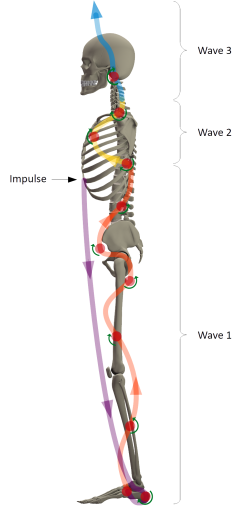
We infiltrate the music in 5 areas in the body, which in musical terms could be referred to as “registers”:
-
Wave 1, Ground base:
From rib 8 as an impulse to the heel and up to the pelvisThe groundness and depth of the music played is related into the earth – before it starts with the acceleration in the heel and the root of the foot.
-
Wave 1, Pelvis area:
From sitting bone to pelvis to L4 -
Wave 1, Upper base:
From L4 up to the gravity of the spine, ending under the shoulder blade -
Wave 2, Melody area:
From under the tip of the shoulder blade, through and along the inside of the chest bone, up to C5 -
Wave 3, “Fulfillment of the feeling of the music” area:
From C5 through the atlas and skull and out of the fontana
Pulse
Pulse is the base of the sound and vibration in the base.
The base pulse is created between rib 8, the root of the foot (heel) and the pelvic floor.
Acceleration Points
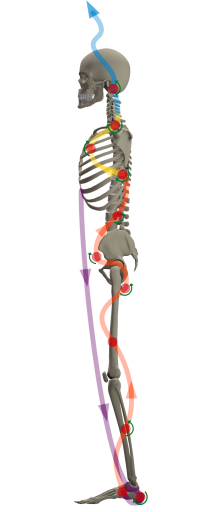
In all these areas, acceleration points “scoop up” the music so that the level of the played tones fits to the corresponding body area.
Highest Level: Expressing Rhythm with Inner Elasticity
When the flow flows, the vibration between the given beats creates elasticity between and through them to blend together (“legato”).
This flow is the bridge to be able to feel the rhythm to use it.
To have built up internal activity skills is necessary to be able to hesitate and release to create a given pattern of rhythm.
Expressing the rhythm is only possible when the internal activity skills are combined by the feeling of the activity from the T5 action area in relationship and communication with the foot.
Rhythm is the impulse (created through compression in relation to foot) of T5 to the accents of the music
(a “dynamic use of golden bone”)
Impulses in the music are activated in the body rise first — before they express themselves into the space.
Without the technical skills to feel and create the rhythm, expression of musicality is not possible.
Musicality
Musicality can be looked at from two angles:
-
The extended flow from a rhythm pattern fulfills and extends the top part of the chest including neck line, head and hands
-
The total expression of musicality is when the inner energy is shown into the space through all body parts.
This state is possible by merging the state of body and mind to be free to be one instrument or voice of the music.
Therefore, the total release to be able to leave behind the slavery of controlling the inner activity to be able to be the music with your inner voice and energy.
The Road to Become Musical
-
Feet placed to the played beat
-
Feel the vibration of the beat to feel the flow – enjoying the feeling of “legato”
-
Feel and use the flow of the body without any accents
(Start by activating the upper part of the thigh)
-
Create flowing beats
Research of Functional Anatomy
- New possibilities of expressing freedom
- Now: How to infiltrate the music?
“What does coordination sound like?” – Expressing freedom through sound
Vibration between Man and Lady
Examples:
-
Preparation for Preparation step:
Man’s tone: A2 (deeper sound)
Lady’s tone: A4 (higher sound)
-
Natural Turn, Beat 3:
Man: B4
Lady: A5
Tuning in Man –> Lady of the extension is the same
Accent/Vibration of Man-Lady in movement is different
Harmony between partners — “a fitting sound”
Male/female voices are usually about one octave apart
The same use of Klang in man and woman are sounding differently because of the construction of the bodies, bone and flexibility of inner space create different Klang and volume to create intensity between man and woman to merge two different bodies to look dynamic.
- Let go to make the body ready to resonate
-
To let music infiltrate the body
-
To make your total inner space fulfilled
-
To sense and feel the vibration of the music
-
To let the body take the vibration to be the music.
Making the vibration fit to certain body parts, we call “pitching”.
Statements on Music
2020
Total awareness of feeling the emotion of the breathing body to express the music through the movement.
Infiltrate and absorb the music with all your cells in your body to be the music.
Infilter the music into all the cells of your body to feel and be the music.
The Power of the Li energy is coming from the pulse of the music.
The pulse is creating the vibration length of the beat to continue the flow to become a rhythm.
Total awareness of feeling the emotion of the movement of the breathing body to express the music – to be the music.
Before 2020
When body rise and the use of the foot are communicating together, there is flow in the movement. (bridge of their relationship?)
I am the body rise with music.
Music is creating a mood in the body.
Music is filling up the total awareness with the mood
–> Filling up the inner space with the music (infiltrating it)
Musicality is
-
the elasticity of the movement in relation to the (subdivisions) of the beats
–> Total result of improvisation between mood, beat, once own natural expression and the feeling of it
-
the resonance of sound/vibration after hitting the key on the piano
-
the reaction of using T5 in to the head and hands (compression/pumping into T5)
Li power is the mood of the total beats
–> on top of that, you can have individual expression
Breathing — Connection — Total Schwung
Musicality is the release of extension of this activity. (which one exactly?)
Release of drift of your inner feeling of the ????
Further Research
Timing — Structure of Movement in Time – How to Live Beats
Timing: “The amount of time assigned to a movement”
The duration of time of a bar is divided into equal parts, called “beats”
⇝ Beats are not just points in time, but have a duration!
⇝ Fill all the beats with body movement!
Associate movements to specific time instance:
-
Beat: Place foot to mark beginning of beat
-
“and”: Weight arrives on new foot
-
“e”: Squeeze chest (representing voice)
-
“i”: Let explosion happen
“Orchestra of joint instruments”
Phrase: Count 1-6 or 1-8
–> “Verses”: 8 times 4 = 4 times 8 or 8 times 3 = 4 times 6
Breathing (Richard Gleave)
Connect to Music through breathing
Inhale ⇝ Slow down
Exhale ⇝ Speed up
Two bar breathing in Waltz: 5: in 6 1: out 2: less out 3 4: out
“Breathing is the life-blood of phrasing to music → the key factor to being phrased”
Breath together – tune energies together
Breathing activates central muscles
Phrasing (Richard Gleave)
Question – Answer Structure
“pick-up” or “lead in” (like an introduction) at the end of the soft bar (= every second one)
to lead into the following strong bar
Masculine/Feminine parts of a bar
Metrical Stresses – Rhythmical Accents (first and secondary accents):
Strong (“down”) beats are collected towards – accented beats are released towards
Interpretation (Luca Baricchi)
-
On Time
-
Legato
-
Staccato
-
Rubato Action
Constant awareness of music and communication ⇝ Constant interest
Chakra tones
-
Crown or 7th chakra – “I Understand”, spirituality, wisdom, God (violet) – Tone “F”
-
Third eye or 6th chakra – “I See”, intuition, awareness, charisma (indigo blue) – Tone “E”
-
Throat or 5th chakra – “I Speak”, expression, inspiration, truth (light blue) – Tone “D”
-
Heart or 4th chakra – “I Love”, love, compassion, integration (green) – Tone “C”
-
Solar Plexus or 3rd chakra – “I Do”, power, wisdom, social self, will (yellow) – Tone “B”
-
Sacral or 2nd chakra – “I feel”, sexuality, creativity, emotion (orange) – Tone “A”
-
Root or 1st chakra – “I Am”, grounding, basic trust, stability (red) – Tone “G”
Chakra Frequencies:
3 528 Hz C5
4 639 Hz D#5
5 741 Hz F#5
(A4 = 442 Hz)